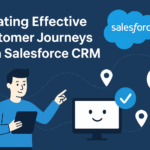


In today’s competitive landscape, understanding and optimizing the customer journey is paramount for businesses aiming to enhance customer satisfaction and drive loyalty. Salesforce CRM has become a powerful tool for businesses seeking to create seamless and effective customer journeys. This article will explore how Salesforce CRM facilitates the mapping, analysis, and optimization of customer journeys, leading to improved customer experiences and enhanced business outcomes.
Understanding the Customer Journey
The customer journey refers to the series of interactions a consumer has with a brand, from initial awareness through the stages of consideration, purchase, retention, and advocacy. Each touchpoint—be it social media interactions, email campaigns, or in-store experiences—plays a crucial role in shaping the perception of the brand. Understanding these touchpoints and the customer’s emotional responses to them can help businesses create personalized experiences that foster loyalty and drive repeat business.
The Role of Salesforce CRM
Salesforce CRM is a customer relationship management platform that helps organizations understand customer needs through data and analytics. It offers various features that significantly enhance the ability to create and manage customer journeys effectively, making it an invaluable tool for marketers, sales personnel, and customer service representatives.
Key Features of Salesforce CRM for Customer Journey Mapping:
-
360-Degree Customer View: Salesforce captures complete customer profiles, allowing businesses to see a consolidated view of interactions, preferences, and behaviors. This assists in understanding the customer journey more holistically.
-
Journey Builder: Salesforce Marketing Cloud includes a feature called Journey Builder, allowing businesses to visually map customer journeys. This feature enables organizations to design automated marketing campaigns that trigger specific messages based on customer behavior and actions.
-
Analytics and Reporting: With robust analytical tools, Salesforce allows businesses to track the performance of various customer journey stages. This data-driven approach helps identify pain points, optimize touchpoints, and make informed decisions.
-
Personalization: Salesforce’s AI-powered feature, Einstein, analyzes data to deliver personalized content, recommendations, and interactions across the entire customer journey, enhancing overall customer experience.
-
Integration Capabilities: Salesforce integrates seamlessly with various applications and tools—such as social media platforms, email marketing services, and e-commerce solutions—allowing organizations to maintain a coherent approach across all stages of the customer journey.
Steps to Create Effective Customer Journeys with Salesforce CRM
Step 1: Mapping Customer Journeys
Start by mapping out the customer journeys relevant to your business. Identify key personas and their typical paths, noting important touchpoints along the way. This can be accomplished with Salesforce’s Journey Builder, which provides a visual representation to better understand customer interactions.
Step 2: Collecting Data
Utilize Salesforce to gather data across various channels. Capture insights on customer preferences, behaviors, and demographics. The more data you collect, the better equipped you’ll be to understand and enhance customer experiences.
Step 3: Personalization
Use the data collected to personalize interactions. Salesforce’s AI features can help tailor communication based on customer behavior and preferences, ensuring messages resonate with the target audience. For instance, you can automate email campaigns that deliver appropriate content based on previous interactions.
Step 4: Automating Communication
Implement automation via Salesforce to streamline communication during each stage of the customer journey. Automated responses and follow-ups can help maintain engagement and speed up response times.
Step 5: Performance Tracking and Analytics
Leverage Salesforce’s analytics tools to monitor customer interactions and journey performance. Regularly assess which tactics are working and which are not. Adapt strategies based on these insights to optimize the journey further.
Step 6: Continuous Improvement
Customer journeys are not static; they change as consumer behavior evolves. Regularly collect feedback and conduct A/B tests to refine your approaches. Use Salesforce’s reporting tools to track key performance indicators (KPIs) and understand where improvements can be made.
Real-World Application
Consider a retail brand that utilizes Salesforce CRM to enhance its customer journey. Initially, they discover through analytics that a significant number of customers abandon their shopping carts. By mapping the customer journey, they identify communication gaps. Following this, they implement personalized retargeting campaigns using Journey Builder that remind customers about their abandoned carts, offering incentives such as discounts.
As a result of leveraging Salesforce’s automation features, they increase conversion rates and customer retention. Their analytics show a decrease in abandoned carts, illustrating the effectiveness of their optimized customer journey.
Conclusion
In an era where customer expectations are continually evolving, creating effective customer journeys is critical for business success. Salesforce CRM provides the tools and capabilities needed to understand, personalize, and automate customer interactions throughout every stage of the journey. By harnessing these features, businesses can foster deeper connections with consumers, leading to increased customer satisfaction, loyalty, and ultimately, business growth.
FAQs
1. What is Salesforce CRM?
Salesforce CRM is a cloud-based customer relationship management system that enables businesses to manage customer data, interactions, and marketing campaigns effectively. It streamlines processes and provides powerful analytics tools.
2. How can Salesforce help with understanding customer journeys?
Salesforce helps create detailed customer profiles and maps interactions to visualize customer journeys. Its analytical tools provide insights into customer behavior and preferences, allowing businesses to understand their journeys in-depth.
3. What is Journey Builder in Salesforce?
Journey Builder is a feature within Salesforce Marketing Cloud that allows users to design, automate, and personalize customer journeys via visual mapping. It helps trigger marketing actions based on customer behaviors.
4. Can Salesforce integrate with other tools?
Yes, Salesforce can integrate with a wide range of applications, including marketing platforms, e-commerce solutions, and social media tools, facilitating a comprehensive approach to managing customer journeys.
5. How often should I review customer journeys?
Customer journeys should be reviewed regularly—ideally quarterly—to ensure they meet changing consumer behaviors and preferences. A/B testing and customer feedback can aid in identifying necessary adjustments.
By leveraging the capabilities of Salesforce CRM, your business can effectively create customer journeys that not only meet but exceed modern consumer expectations, ultimately driving long-term success.